 Belgrade, Serbia
 info@alu-pvcbogdanovic.rs
 Mon – Fri: 08 AM – 04 PM
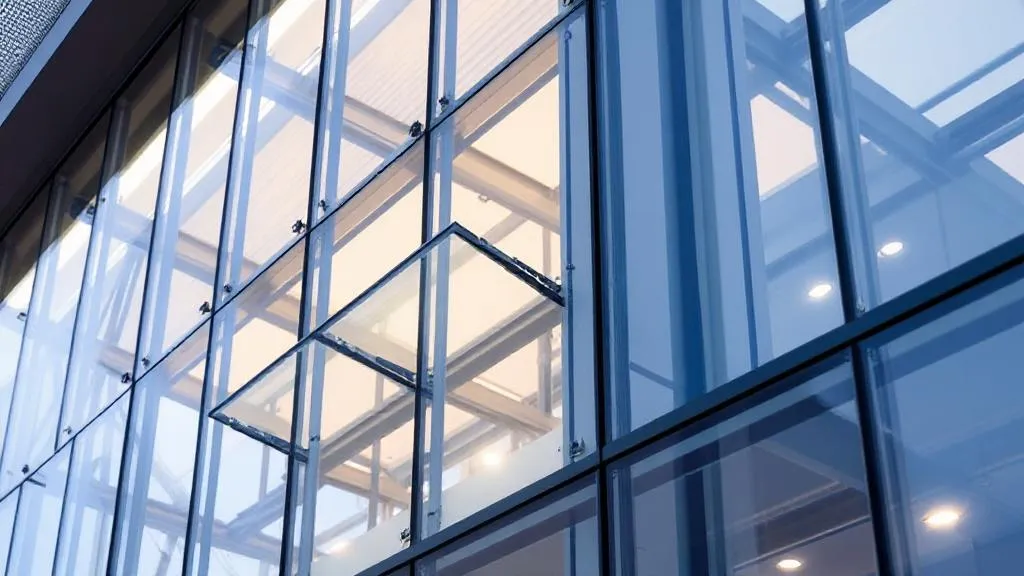
Safety glass for façades – types, standards, and applications
Safety glass for façades is specially processed glass that provides increased resistance to mechanical impact, temperature changes, and potential breakage. In modern architecture, safety glass is a mandatory element of all types of glass façades due to the protection of building users and compliance with construction standards. The most commonly used types of safety glass for façades are tempered and laminated glass, often combined within multi-layer (IGU) units.
Safety glass is an essential component of every glass façade due to its strength, predictable breakage behavior, and compliance with safety standards. By choosing the appropriate type—tempered, laminated, or combined safety glass—according to project requirements and installation height, a durable, stable, and safe glass building envelope is ensured.
Why is safety glass mandatory in façades?
Glass façades cover large surface areas of buildings and are exposed to external and internal mechanical and thermal loads. In the event of breakage of ordinary glass, sharp fragments are produced, posing a direct danger to users. Safety glass is engineered to behave in a predictable and safe manner when damaged.
- Resistance to wind load, hail, impacts, and accidental stresses
- Protection against glass breakage, falling fragments, and injuries
- Compliance with construction and safety regulations
- Possibility of combination with acoustic and thermal protection
Types of safety glass for façades
There are two main categories of safety glass used in façades: tempered and laminated glass. Both variants can be used independently or as part of a multi-layer IGU unit.
- Tempered (heat-treated) glass: Produced by heating glass to a high temperature followed by rapid cooling. It has 4 to 5 times higher impact resistance compared to standard glass. In case of breakage, it disintegrates into small, blunt granules without sharp edges.
- Laminated glass: Two or more glass layers bonded with a safety PVB or EVA interlayer. In case of breakage, the glass remains adhered to the interlayer and does not shatter. It provides additional protection against intrusion and object penetration.
- Combined safety glass: Laminated + tempered glass that combines high impact resistance with safe breakage behavior. Used in high-traffic buildings, schools, shopping centers, and areas with increased risk.
Standards for safety glass in façades
All safety glass used in the construction industry must be manufactured and tested in accordance with European and international standards. The most important standards include:
- EN 12150 – Tempered safety glass
- EN ISO 12543 – Laminated safety glass
- EN 12600 – Impact resistance of glass (safety classification)
- EN 14449 – Rules for laminated glass
- EN 1279 – For IGU units containing safety glass
Application of safety glass in façade systems
Safety glass is used in all types of glass façades, including:
- Structural and semi-structural façades
- Spider façades (laminated glass is mandatory due to point fixing)
- Ventilated façades with an external glass layer
- Façade systems with reflective, UV-protective, or thermal insulation glass
Advantages of using safety glass
The use of safety glass not only increases safety but also enables the fulfillment of multiple functional requirements in modern architecture:
- Increased mechanical resistance and stability
- Reduced risk of injuries and material damage
- Possibility of combination with thermal and acoustic insulation
- Protection against intrusion and impacts in ground-floor zones
- Compliance with legal regulations and building safety requirements
Maintenance and durability
Safety glass does not require specific maintenance. Surfaces are cleaned like standard glass, while laminated layers are protected within IGU units. The service life of the glass and its safety function is long if properly installed and not physically or chemically damaged.
- Cleaning with standard glass-cleaning agents
- Avoiding edge damage on laminated glass
- Regular inspection of joints, hardware, and seals